

To find out, researchers (including previous FoundMyFitness guest Dr. Jari Laukkanen) recruited 51 Finnish adults with an average age of approximately 50 and exposed them to a single 30-minute sauna session at an average temperature of 163°F (73°C). The session consisted of two 15-minute periods separated by a two-minute shower—a fairly moderate protocol (particularly by Finnish sauna standards).
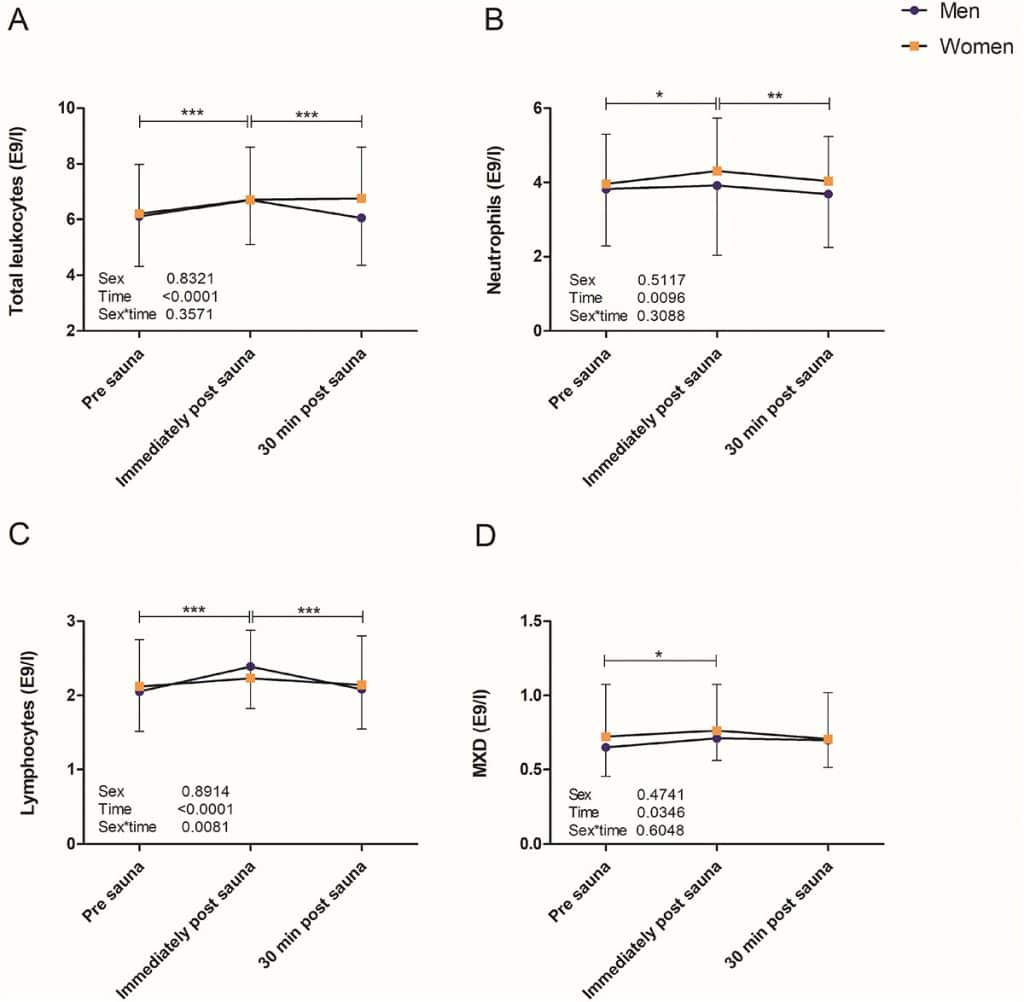
Immediately afterward, circulating white blood cell counts increased in both men and women. Total white blood cells rose by approximately 9.8% in men and 8.1% in women. Looking at specific cell types:
- Neutrophils increased by 2.6% in men and 7.5% in women.
- Lymphocytes increased by 14.3% and 4.8% in men and women, respectively.
- A combined category of monocytes, eosinophils, and basophils—reported as MXD cells—increased by 10.8% in men and 4.2% in women.
These changes were short-lived. With the exception of the MXD cells, circulating immune-cell counts returned to baseline within 30 minutes of recovery.
It is important to be precise about what happened here. The sauna did not cause participants to manufacture a new supply of immune cells within 30 minutes. Instead, it changed how many of those cells were present in the circulation, what I’d describe as immune-cell mobilization or redistribution rather than immune-cell production.
This redistribution occurred without evidence of a broad cytokine response. Of the 37 cytokines measured, only two changed following the sauna. In other words, the increase in circulating immune cells was not accompanied by the kind of generalized acute inflammatory response we might expect if the entire immune system had been strongly activated. The result looks more like a temporary change in immune traffic (cells moving into the bloodstream) than a widespread inflammatory event.
Temperature and sauna experience didn’t alter the response
The study also addressed one of the most common practical questions surrounding sauna: How hot do we actually need to get? Do these physiological responses require us to cross a particular core-body-temperature threshold. This seems to be particularly relevant for heat-shock proteins, but what about immune cells?
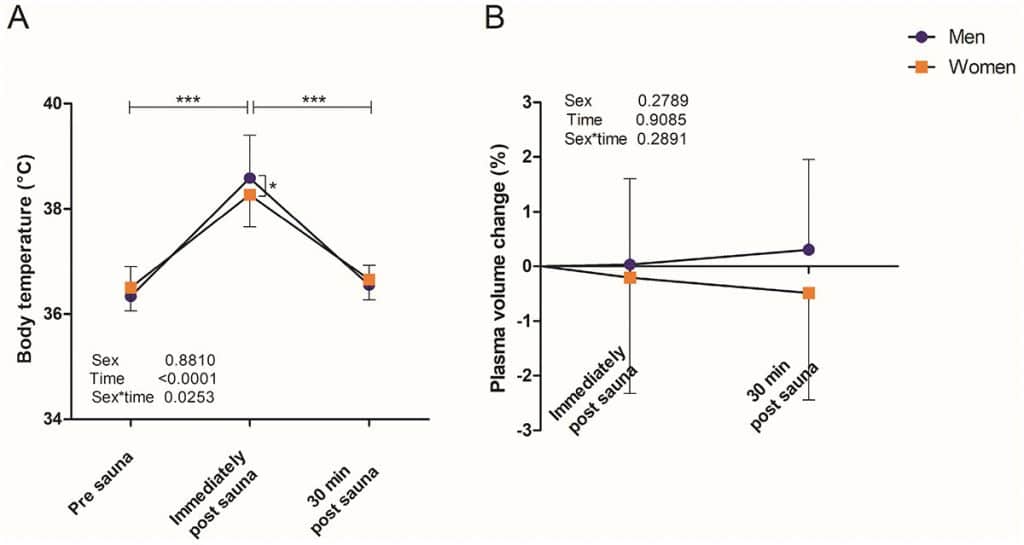
In this case, they did not. Immune-cell mobilization occurred consistently regardless of how much an individual participant’s body temperature increased. Those who became hotter did not show a greater white blood cell response, and those whose temperature rose less did not show a weaker one. This suggests that a large increase in body temperature may not be necessary to trigger the redistribution of circulating immune cells. Getting hot appears to be sufficient.
Prior sauna experience also didn’t appear to make much difference. The researchers compared:
- participants who reported no sauna use at home,
- those using a sauna less than once per week, and
- those using one at least two or three times per week.
Their acute immune-cell and temperature responses were similar. Regular users did not appear to become resistant—or uniquely sensitized—to the immediate response.
None of this demonstrates that a single sauna session improves immune-cell function, enhances antibody production, accelerates viral clearance, kills bacteria, or produces a lasting reduction in inflammation or disease risk. Still, it shows that just 30 minutes of relatively mild sauna exposure can produce a rapid, immune-cell-specific response without triggering broad acute inflammation—and without requiring a dramatic rise in body temperature.
On its own, that response is intriguing, but it’s not complete. Viewed alongside the longer-term associations between habitual sauna use and a lower risk of several illnesses, however, it may offer one small clue about how repeated heat exposure interacts with immune health over time.
Does sauna use improve resilience against illness?
Some of the strongest long-term evidence comes from Finland.1
Researchers followed 1,935 middle-aged men for nearly 26 years.
- Compared with men who used a sauna no more than once per week, those who used one two to three times weekly had a 27% lower risk of developing a respiratory condition (i.e., pneumonia, asthma, or chronic obstructive pulmonary disease).
- Among those using a sauna four or more times per week, the risk was 41% lower.
- When the researchers looked specifically at pneumonia, two to three weekly sauna sessions were associated with a 28% lower risk, while four or more were associated with a 37% lower risk.
The evidence involving the common cold is much smaller, but it is also more directly experimental. In one controlled trial, 25 volunteers used a sauna regularly while another 25 avoided sauna and similar heat treatments.2 Over six months, the sauna group experienced significantly fewer colds. The difference emerged primarily during the final three months, when the number of colds was approximately half that observed in the control group.
Sauna did not, however, make the colds that occurred shorter or less severe, a distinction supported by another randomized trial where researchers assigned people with a newly acquired cold to inhale either hot, dry sauna air or room-temperature air through a face mask during three days of treatment.3 The heated air did not meaningfully reduce their overall symptom burden. In other words, sauna-like heat may be more relevant as a repeated physiological exposure than as a “remedy” for an infection already underway.
How, then, might habitual sauna use influence respiratory resilience?
The acute immune-cell mobilization described in the new study may be one piece of the picture, but repeated sauna exposure could produce a somewhat different effect at rest. In another long-running Finnish study, frequent sauna use was associated with lower resting levels of C-reactive protein, fibrinogen, and circulating white blood cells—all markers that can reflect systemic inflammation.4At first glance, a temporary increase in circulating white blood cells after one sauna session and a lower resting white blood cell count among habitual users might seem contradictory. I do not think they necessarily are. Exercise produces a similar pattern: A single bout creates a brief, coordinated stress response, while repeated exposure can produce adaptations that support a less inflammatory baseline environment.
Let’s keep on the topic of inflammation, because it may be particularly relevant to pneumonia. In an analysis of 2,264 Finnish men, those with elevated levels of C-reactive protein (CRP) had a greater risk of developing pneumonia, while frequent sauna use was associated with lower risk. Among men with elevated CRP, the excess pneumonia risk was lower in those who used a sauna frequently!5
Again, this does not demonstrate that sauna neutralized the effects of inflammation. But it supports inflammation as one plausible pathway connecting habitual heat exposure with respiratory health.
For now, the long-term findings are promising, the biological rationale is plausible, and the experimental evidence is suggestive—but sauna should not be viewed as either an established infection-prevention strategy or a treatment for an illness that has already begun.
You can read more research on the benefits of sauna on our Sauna Topic Page.
What about cold exposure?
If heat can influence immune activity, what about the opposite temperature stressor?
Cold showers, cold plunges, and winter swimming also activate the sympathetic nervous system, increase stress hormones, and temporarily alter immune and inflammatory signals. But despite their growing popularity, the evidence that cold exposure actually prevents respiratory illness is thinner than the evidence for sauna use.
The largest experiment involved 3,018 healthy adults in the Netherlands. Participants were randomly assigned either to continue taking their usual showers or to finish each shower with 30, 60, or 90 seconds of cold water for 30 consecutive days.6
- Over the 90-day study, the cold-shower groups reported 29% fewer days of sickness absence from work.
- Extending the cold-water exposure from 30 seconds to 60 or 90 seconds also provided no additional benefit.
That sounds like strong evidence that cold showers prevented illness, but there is an important distinction: Participants did not report fewer days of actually feeling ill. Maybe the cold showers improved perceived energy, increased tolerance of mild symptoms, or simply made participants more willing to work while feeling unwell. Whatever the explanation, the trial demonstrated fewer absences, not fewer infections or fewer colds.
The findings from cold-water swimming are similarly intriguing but difficult to interpret.
In one 13-week study, cold-water swimmers experienced fewer cold symptoms than their non-swimming partners. But they did not experience fewer infections than a group of people who swam in heated indoor pools—both swimming groups tended to fare better than non-swimmers, suggesting that swimming itself or differences in exercise habits, lifestyle, and general health may have explained the apparent benefit more than the cold water.7
Other studies rely primarily on self-reported experience.
- Winter swimmers reported fewer common colds than non-swimmers, but they did not report less influenza or milder influenza symptoms.
- Approximately 40% of ice swimmers in one survey said their respiratory infections had become less frequent, milder, or shorter after they began winter swimming.8,9
Mechanistic studies offer another piece of the puzzle. Exposure to 41°F (5°C) air for two hours increased circulating leukocytes, granulocytes, natural killer cells, natural-killer-cell activity, and interleukin-6. In a small experiment, participants immersed themselves in 57°F (14°C) water for one hour, three times per week, over six weeks. The repeated exposure produced modest changes in monocytes, activated lymphocytes, tumor necrosis factor-alpha, and several acute-phase proteins.10,11
As with the acute sauna study, however, changes in circulating immune markers do not necessarily mean improved resistance to infection. They tell us that the body recognized the cold as a physiological stressor and altered immune activity in response. They do not tell us whether immune cells became better at identifying pathogens, clearing viruses, or preventing respiratory illness.
The cold evidence therefore has an interesting but incomplete shape. Cold exposure clearly produces a strong physiological stress response and can alter the distribution or activity of circulating immune cells. Cold showers may reduce days away from work, and some winter swimmers report fewer common colds. But controlled evidence does not yet demonstrate that cold exposure reliably prevents colds or influenza.
Original article can be found here: https://r.sib.foundmyfitness.com/mk/mr/sh/7nVTPdZCTJDXOk8q8UTxJitKPqrSYte/I8kG9hYrljt3